
Choosing the perfect diamond can feel overwhelming — with so many grades, scales, and abbreviations, it's hard to know where to start. Whether you're shopping for an engagement ring or building a curated jewellery box, understanding diamond clarity is one of the most valuable things you can learn before making a purchase.
At Fyne, we believe in empowering you with knowledge. As the Middle East's first lab-grown diamond jewellery brand, we only use VVS to VS1 clarity diamonds in our pieces — because we believe you deserve brilliance without compromise. This guide will walk you through everything you need to know about the diamond clarity scale, from the GIA grading system to practical buying advice that helps you find the right stone for your style and budget.
What Is Diamond Clarity?
Diamond clarity refers to the visual purity of a diamond, specifically the relative absence of internal characteristics known as inclusions and surface imperfections called blemishes. According to the Gemological Institute of America (GIA), clarity is assessed based on the size, number, position, nature, and visibility of these characteristics under standard 10× magnification.
Every diamond — whether formed deep within the earth or grown in a laboratory — develops under extreme heat and pressure. During this process, tiny natural marks appear. Internal marks are called inclusions, while those found on the diamond's surface are referred to as blemishes. It's important to note that these characteristics are not always visible to the naked eye; most require a microscope or jeweller's loupe to detect.
What makes every diamond truly remarkable is that no two are identical. Even diamonds grown in the same laboratory batch will have a unique pattern of characteristics, giving each stone its own "fingerprint." This is part of what makes your diamond — and the jewellery it's set in — entirely yours.
Clarity is one of the universally recognised 4Cs of diamond quality, alongside cut, colour, and carat weight. Together, these four factors determine a diamond's beauty, rarity, and value. Among them, clarity plays a specific role: it speaks to the internal story of how the diamond was formed and directly influences how light travels through the stone.
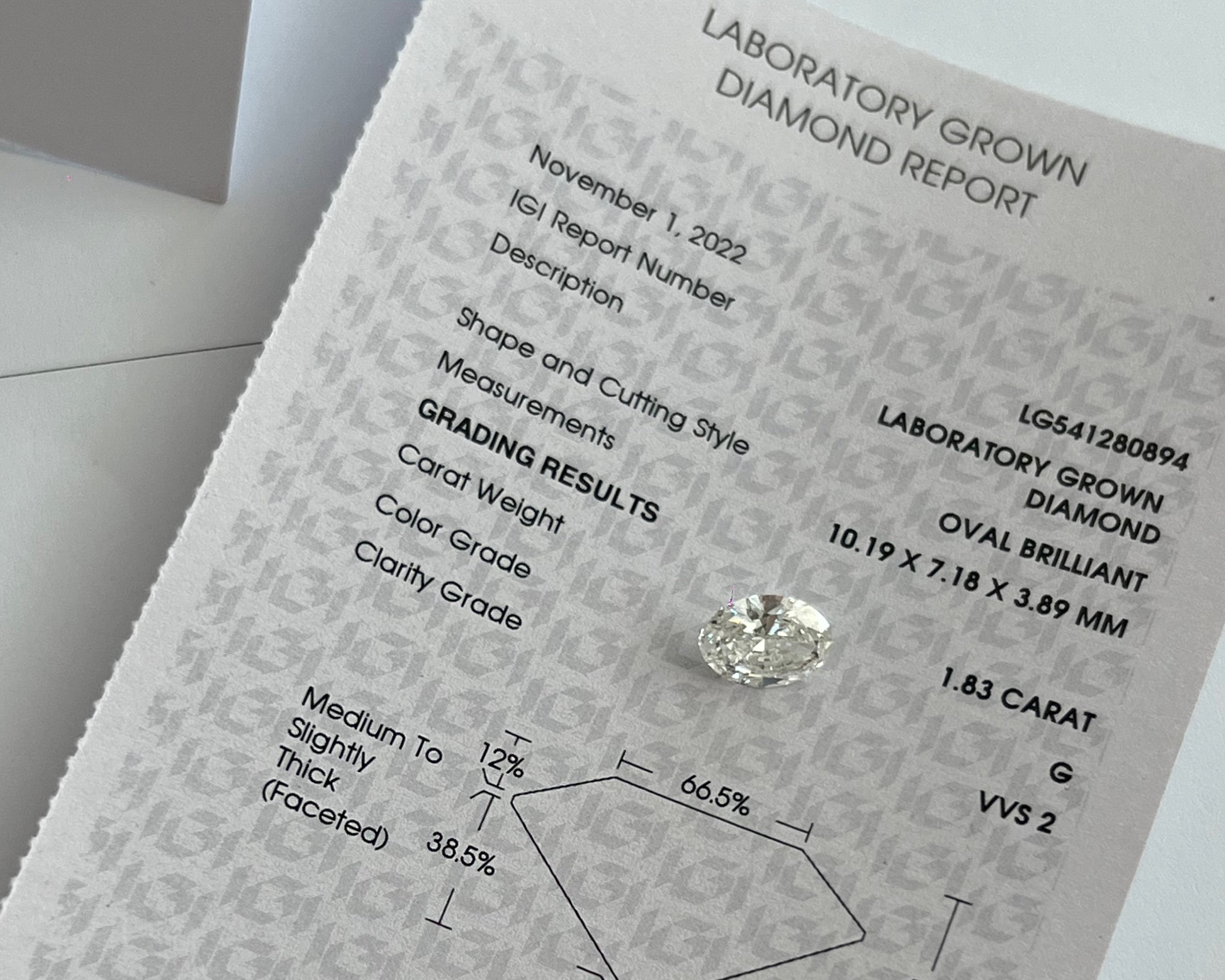
When it comes to lab-grown diamonds, the clarity grading process is exactly the same as for earth-mined stones. Lab-grown diamonds are chemically and physically identical to natural diamonds, and they are assessed by the same grading laboratories using the same criteria. The key difference is that lab-grown diamonds are created in a controlled environment, which often results in fewer and less significant inclusions — though, like their natural counterparts, no lab-grown diamond is guaranteed to be flawless.
For a once-in-a-lifetime piece, explore Fyne's diamond rings. Our 18 karat solid gold jewellery with sustainable lab-grown diamonds makes the perfect engagement ring or gift for a special occasion.
The GIA Diamond Clarity Scale Explained
The diamond clarity scale we use today was established by the Gemological Institute of America (GIA) in 1953. Before this standardised system existed, the diamond industry relied on inconsistent and often confusing terminology — jewellers would use words like "water" or "river" to describe how clear a diamond looked. The GIA changed everything by introducing a universal grading language that is now used by gemologists, jewellers, and retailers worldwide.
The GIA diamond clarity scale uses 10× magnification as the global standard for assessment. Every diamond is examined face-up under a loupe or microscope at this fixed magnification, and a trained grader evaluates the stone based on what they observe. This standardised approach ensures consistency whether a diamond is graded in Antwerp, Dubai, New York, or Mumbai.
The scale is divided into six main categories, which break down into 11 individual clarity grades. From the very top of the scale to the bottom, here is what each grade means and how it affects your diamond's appearance and value.
Flawless (FL)
A Flawless diamond shows no inclusions and no blemishes whatsoever when examined under 10× magnification by a skilled grader. To the naked eye, these diamonds are absolutely pristine — and under a microscope, they remain so.
Flawless diamonds sit at the very pinnacle of the diamond clarity chart. They are extraordinarily rare — fewer than 1% of all gem-quality diamonds ever receive this grade. Because of their extreme rarity, they command the highest prices on the market and are typically sought by collectors and investors rather than everyday jewellery buyers.
Internally Flawless (IF)
Internally Flawless diamonds have no internal inclusions visible under 10× magnification. They may, however, have very minor surface blemishes — tiny marks from the cutting or polishing process that a skilled grader can detect.
To the naked eye, an IF diamond is indistinguishable from a Flawless stone. The price difference between FL and IF can be significant, yet the visual difference is virtually nonexistent when worn. IF diamonds are still exceptionally rare and represent the upper echelon of diamond quality.
VVS1 vs VVS2 — Very, Very Slightly Included
VVS diamonds contain inclusions that are extremely difficult for even a trained grader to detect under 10× magnification. The distinction between VVS1 and VVS2 comes down to visibility and position:
VVS1 inclusions are so minute that they are extremely difficult to locate, even for an experienced gemologist. They are typically positioned towards the outer edges of the diamond or on the pavilion side, making them nearly impossible to see through the table.
VVS2 inclusions are still very difficult to spot under magnification but are slightly more detectable than VVS1 — often because of their position closer to the centre of the stone. Despite this, VVS2 diamonds are entirely eye-clean, meaning inclusions are invisible without magnification.
Both VVS1 and VVS2 diamonds are considered premium clarity grades. The price difference between the two can be notable depending on carat weight and other factors.
VS1 vs VS2 — Very Slightly Included
VS diamonds contain minor inclusions that range from difficult to somewhat easy to observe under 10× magnification. This is where the diamond clarity scale starts to offer a compelling balance between quality and value.
VS1 diamonds have inclusions that require considerable effort to locate under magnification. A trained grader may need to spend time searching for them, and they are always completely invisible to the naked eye. VS1 is widely considered one of the best value grades on the diamond clarity chart — you get near-premium quality with a noticeable price saving compared to VVS grades.
VS2 diamonds have inclusions that a trained grader can find somewhat more easily under magnification. However, VS2 diamonds are still overwhelmingly eye-clean, meaning the average person will never see these characteristics without a loupe. VS2 is frequently recommended by industry experts as the "sweet spot" where beauty and budget meet.
The probability of a VS2 diamond being eye-clean is very high for brilliant-cut shapes like round, oval, and cushion. For step-cut shapes like emerald or asscher, the probability drops somewhat due to the open facet structure.
SI1 vs SI2 — Slightly Included
Slightly Included diamonds have inclusions that are noticeable to a trained grader under 10× magnification and, depending on the specific stone and shape, may become visible to the naked eye.
SI1 diamonds often represent the last tier of eye-clean options in brilliant-cut diamonds. Many SI1 round and oval diamonds will appear clean to the naked eye, though this varies stone by stone. If you're shopping for maximum value and are willing to evaluate each diamond individually, SI1 can be a smart choice — particularly in shapes with many facets that help mask inclusions.
SI2 diamonds have inclusions that are more clearly visible under magnification and, in many cases, can be spotted without any magnification at all — especially in step-cut shapes like emerald and asscher. The transparency concerns here are worth noting: some SI2 diamonds may appear slightly hazy or lack the crispness of higher-clarity stones.
When considering SI-grade diamonds, it's important to examine the specific stone rather than relying on the grade alone. Two SI1 diamonds can look very different depending on the type, size, and location of their inclusions.
I1, I2, I3 — Included Diamonds
Diamonds at the bottom of the diamond clarity scale fall into the Included category. These stones have inclusions that are obvious under magnification and typically visible to the naked eye without any equipment.
I1 inclusions can be spotted quickly and may begin to affect the diamond's brilliance and transparency. Some I1 diamonds are still wearable, but the visual impact is noticeable.
I2 diamonds have clearly observable inclusions that compromise brilliance and beauty. The light performance of these diamonds is measurably reduced.
I3 diamonds have prominent inclusions that significantly affect transparency, brilliance, and potentially even the structural durability of the stone. These diamonds are at the lowest end of the clarity scale and carry the most risk.
Most reputable jewellers — Fyne included — do not use I-grade diamonds. The risk to both appearance and long-term durability makes them unsuitable for fine jewellery that is meant to be treasured and passed down for generations.
Diamond Clarity Chart (Visual Scale Overview)
The following diamond clarity chart provides a complete overview of all 11 grades, from Flawless at the top to I3 at the bottom. Use this as a quick reference when evaluating diamonds.
Clarity Grade |
Full Name |
Visible Under 10× Magnification |
Visible to Naked Eye |
Eye-Clean? |
Rarity |
Value Recommendation |
FL |
Flawless |
No inclusions or blemishes |
No |
Yes |
Extremely rare |
Collector/investment grade |
IF |
Internally Flawless |
Minor surface blemishes only |
No |
Yes |
Very rare |
Premium luxury |
VVS1 |
Very, Very Slightly Included 1 |
Extremely difficult to detect |
No |
Yes |
Rare |
Excellent quality ✦ |
VVS2 |
Very, Very Slightly Included 2 |
Very difficult to detect |
No |
Yes |
Rare |
Excellent quality ✦ |
VS1 |
Very Slightly Included 1 |
Difficult to detect |
No |
Yes |
Uncommon |
Best value-to-quality ✦ |
VS2 |
Very Slightly Included 2 |
Somewhat easy to detect |
No |
Yes (95%+) |
Common |
Strong value |
SI1 |
Slightly Included 1 |
Easy to detect |
Sometimes |
Variable |
Common |
Budget-conscious |
SI2 |
Slightly Included 2 |
Very easy to detect |
Often |
Unlikely |
Common |
Caution advised |
I1 |
Included 1 |
Obvious |
Yes |
No |
Abundant |
Not recommended |
I2 |
Included 2 |
Obvious |
Yes |
No |
Abundant |
Avoid |
I3 |
Included 3 |
Obvious |
Yes |
No |
Abundant |
Avoid |
✦ We use VVS to VS1 clarity diamonds exclusively.
As you move up the diamond clarity chart from I3 to FL, diamonds become progressively rarer, more visually pristine, and more valuable. However, the visual difference between adjacent grades — especially in the upper half of the scale — is often imperceptible to the naked eye. This is why understanding the scale is so valuable: it helps you make informed decisions rather than overpaying for differences you'll never see.
How Diamond Clarity Is Graded
Understanding how diamonds are graded for clarity goes beyond simply looking at a scale. Professional graders evaluate every diamond against five specific factors that, together, determine where the stone falls on the clarity chart. Knowing these factors can help you read a grading report with confidence.
The 5 Clarity Factors
Size — The larger an inclusion, the greater its impact on the clarity grade. A single large inclusion can lower the grade more dramatically than several tiny ones. Size is always assessed relative to the overall dimensions of the diamond, so the same inclusion might be more significant in a smaller stone than in a larger one. Inclusions with the greatest impact are called "grade setters" because they are the primary marks that determine the final grade.
Number — When a diamond is viewed face-up under 10× magnification, the total number of visible inclusions is counted. Generally, more inclusions mean a lower clarity grade. However, number alone rarely determines the grade — a diamond with several very tiny pinpoints may still grade higher than one with a single prominent feather.
Location — Where an inclusion sits within the diamond matters significantly. Inclusions located at the "centre of the table" (the flat top facet) are the most visible and have the greatest impact on the grade. Inclusions closer to the girdle (the outer edge) are more difficult to notice. Inclusions near the pavilion can sometimes reflect through the diamond's facets, effectively multiplying their visual impact.
Nature — This factor considers the type of inclusion and whether it is entirely internal or reaches the surface of the diamond. Surface-reaching inclusions are considered more significant because they can, in rare cases, affect the structural integrity of the stone. The nature assessment also takes into account how deep or shallow the inclusion sits within the diamond's structure.
Relief — Relief refers to the contrast between the inclusion and the surrounding diamond material. A dark inclusion against a colourless diamond will have high relief and be more noticeable than a white or transparent inclusion in the same position. Relief doesn't describe the colour of the inclusion per se, but rather how visible it is relative to its background.
These five factors work together. A skilled grader weighs all of them simultaneously — a small, well-positioned inclusion with low relief will affect the grade far less than a large, centrally located inclusion with high contrast.
Understanding the Diamond Clarity Plot
When you receive a diamond grading report from the GIA, IGI or another respected laboratory, you'll often see a clarity plot — essentially a map of your diamond's characteristics. The plot uses standardised symbols to show where inclusions and blemishes are located.
On a GIA report, red symbols typically indicate internal inclusions, while green symbols represent surface blemishes. Each type of characteristic has its own symbol: circles for pinpoints, lines for feathers, triangles for crystals, and so on.
Learning to read a clarity plot helps you understand not just the grade but the story behind it. Two diamonds with the same VS2 grade might have very different plots — one might have a single feather near the girdle, while another has several pinpoints scattered across the table. This is why looking beyond the grade to the actual plot can help you make a more informed decision.
Surface-reaching inclusions — those that extend from the interior to the outer surface of the diamond — are particularly worth noting on a clarity plot. While these rarely affect diamonds graded VS1 and above, they can be a durability consideration in lower-clarity stones.
Diamond Inclusions & Blemishes Guide
Every diamond tells its own story through its inclusions and blemishes. Understanding the different types helps you interpret grading reports and make confident choices. Here's what you might encounter.
Common Internal Inclusions
Crystal — A mineral crystal trapped inside the diamond during formation. Sometimes these look like a tiny diamond within a diamond. They can be colourless or tinted depending on the mineral.
Feather — A small fracture within the diamond that resembles a feather or a fine crack. Depending on the angle and lighting, feathers can appear white, transparent, or slightly reflective. Most feathers in well-graded diamonds pose no durability risk.
Cloud — A cluster of extremely tiny pinpoint inclusions grouped closely together. Under magnification, they can create a faintly hazy or cloudy appearance. In higher-clarity grades, clouds are typically too small and sparse to affect the diamond's visual performance.
Needle — A long, thin, rod-like inclusion that usually appears white or transparent. Needles form when diamond crystals grow in elongated shapes rather than rounded ones. They are generally benign and difficult to spot without magnification.
Pinpoint — The most common type of diamond inclusion. Pinpoints are extremely small crystals that appear as tiny dots — often near the table of the diamond. Individually, they have virtually no impact on appearance, though clusters of pinpoints may form a cloud.
Knot — A diamond crystal inclusion that extends to the surface of the polished stone. Knots can sometimes be felt with a fingernail and may appear as a raised area on the diamond's facet.
Graining — Caused by irregular crystal growth, graining appears as white, coloured, or reflective internal lines. It can create a slightly hazy appearance in some diamonds.
Twinning Wisps — A series of inclusions that formed during the diamond's crystal growth, often appearing as intertwined ribbons of pinpoints, clouds, and crystals. These are particularly common in fancy-shaped diamonds.
Cavity — An opening on the surface of the diamond created during the polishing process when an internal inclusion is dislodged. Depending on the minerals involved, cavities can be colourless or slightly tinted.
Internal Laser Drill Channel — A tiny tunnel created by laser drilling used to reach and treat dark inclusions within a diamond. This is a form of clarity enhancement and will always be disclosed on a grading report.
Common External Blemishes
Scratch — A fine line on the diamond's surface, usually caused by contact with another diamond or abrasive material. Superficial scratches can often be removed through re-polishing.
Pit — A tiny opening on the diamond's surface that appears as a small dot. Pits can result from the polishing process or from a crystal inclusion being pulled from the surface.
Chip — A small piece of the diamond that has broken away, typically along a facet edge or at the culet. Chips are usually caused by accidental impact.
Natural — An unpolished portion of the original rough diamond surface that remains on the finished stone, usually found along the girdle. Naturals indicate that the cutter maximised the diamond's weight.
Abrasion — A series of tiny nicks along facet junctions that create a slightly fuzzy appearance at the edges. Abrasions are caused by wear or contact with other diamonds.
Rough Girdle — A grainy or pitted texture on the diamond's girdle that hasn't been fully polished. This is an external characteristic that can affect the diamond's overall finish grade.
Polish Lines — Fine lines left on the diamond's surface from the polishing wheel. These are usually only visible under magnification and rarely affect a diamond's beauty when viewed with the naked eye.
Best Value Diamond Clarity Grades
When it comes to finding the ideal balance between beauty and budget, not all clarity grades are created equal. Understanding where the best value lies on the diamond clarity chart can save you significantly without sacrificing the visual appeal of your diamond.
VS2 and VS1 are widely considered the "sweet spot." These grades offer diamonds that are reliably eye-clean, beautifully transparent, and priced well below VVS and Flawless options. For most engagement rings and fine jewellery, VS-grade diamonds deliver a premium look without the premium price tag.
SI1 can offer exceptional value — with caveats. In brilliant-cut shapes (round, oval, cushion, radiant, and pear), SI1 diamonds frequently appear eye-clean because the facet structure scatters light in a way that masks many inclusions. However, this is not guaranteed, and each SI1 diamond should be individually assessed. For step-cut shapes like emerald and asscher, SI1 inclusions are more likely to be visible.
VVS grades are worth considering when:
You want the highest quality without paying for Flawless rarity. You're choosing a step-cut diamond (emerald or asscher) where clarity is more exposed. The diamond is a significant carat weight (2 carats and above), where inclusions become more visible. You value the peace of mind that comes with near-perfect clarity.
Avoid I1 through I3 for fine jewellery. Diamonds in the Included range have visible inclusions that affect sparkle, transparency, and potentially durability. They are not suitable for pieces meant to be worn daily and treasured over time.
The principle of "clarity is rarity" is useful to keep in mind: the higher the clarity grade, the rarer the diamond, and the higher the price. But rarity doesn't always translate to visible beauty. The smartest buying strategy focuses on the grade where beauty is maximised and rarity premiums haven't yet inflated the price — and for most buyers, that falls squarely in the VS1 to VVS2 range.
How Clarity Affects Diamond Price
The relationship between clarity and price is not linear. The most significant price jumps occur at the top of the scale - moving from VVS2 to IF, or IF to FL, can increase the price substantially, even though the visual difference is essentially invisible to the naked eye. You're paying for rarity, not beauty.
In the mid-range (VS1 to VS2, or VS2 to SI1), price differences are more moderate while the visual impact between grades is minimal. This is where savvy buyers find the best value. At the lower end, I-grade diamonds are significantly cheaper, but the savings come with genuine compromises in sparkle, transparency, and durability.
For lab-grown diamonds, the rarity premium is lower across all clarity grades. This means you can often access VVS-quality lab-grown diamonds at prices comparable to VS or even SI mined diamonds — one of the most compelling reasons to consider lab-grown.
How Clarity Affects Appearance & Light Performance
While clarity is technically about what's inside (or on the surface of) your diamond, its practical impact is all about how the diamond looks and performs in the light. Here's how different levels of clarity influence what you actually see.
-
Transparency — Diamonds with higher clarity grades allow light to pass through with minimal obstruction. As you move down the clarity scale, inclusions can interfere with transparency, particularly if they are centrally located or if multiple cloud-type inclusions create a cumulative hazy effect.
-
Brilliance — Brilliance refers to the white light that a diamond reflects back to your eye. Inclusions that sit in the path of light — especially near the table or within the pavilion — can disrupt the way light bounces through the diamond, reducing overall brilliance. In diamonds graded VS1 and above, this effect is negligible.
-
Durability — While most inclusions have no impact on a diamond's structural integrity, certain types — particularly large feathers or surface-reaching inclusions — can create weak points, especially in lower-clarity grades (SI2 and below). For fine jewellery that will be worn daily, choosing a clarity grade where durability is assured is essential.
-
Sparkle and scintillation — Scintillation is the play of light and dark patterns you see when a diamond moves. Significant inclusions can create dark spots or "dead zones" where light fails to return, reducing the sparkle effect. Higher-clarity diamonds deliver more consistent, even scintillation across the entire stone.
Some SI-grade diamonds are described as "cloudy" — this occurs when widespread cloud inclusions or extensive graining reduce the diamond's overall transparency, giving it a milky appearance. Not all SI diamonds exhibit this, but it's a risk factor worth being aware of, particularly with SI2 stones.
Clarity and Diamond Shape
Not all diamond shapes handle clarity equally. The way a diamond is cut directly affects how visible inclusions are to the naked eye, which means your clarity requirements should shift depending on the shape you choose.
Step Cuts (Emerald, Asscher)
Emerald and asscher cut diamonds have long, straight, open facets arranged in a "hall of mirrors" pattern. This elegant facet structure creates stunning flashes of light but offers very little to hide inclusions. Because light travels through these diamonds in broad, clean flashes rather than scattered sparkle, any inclusions tend to be far more visible.
For step-cut diamonds, we recommend prioritising higher clarity — VVS2 or above. At Fyne, this aligns naturally with our commitment to using only VVS to VS1 clarity diamonds, ensuring every emerald and asscher cut in our collection meets the demanding transparency standards these shapes require.
Brilliant Cuts (Round, Oval, Cushion, Radiant)
Brilliant-cut diamonds are designed to maximise light return through dozens of precisely angled facets. This complex facet structure scatters and reflects light intensely, which has the practical benefit of masking many inclusions. A pinpoint or small feather that might be noticeable in an emerald cut can be virtually invisible in a round brilliant.
For brilliant-cut shapes, VS1 to VS2 clarity grades offer an excellent balance of quality and value. Even some SI1 diamonds in these shapes can be eye-clean, though individual assessment is recommended.
Fancy Shapes (Pear, Marquise, Heart)
Fancy-shaped diamonds present unique clarity considerations. The narrow points of pear and marquise cuts can sometimes concentrate light in a way that reveals inclusions near the tips. The "bow-tie effect" — a dark shadow across the centre of elongated shapes — is a cut-related phenomenon, but it can interact with inclusions to amplify their visibility.
Pear shapes generally hide inclusions well in their rounded end but are more revealing near the point. Heart shapes, due to their complex outline, can mask some inclusions effectively. For most fancy shapes, VS2 to VS1 clarity offers a reliable sweet spot, though examining the specific diamond is always advisable.
Clarity and Diamond Size (Carat Weight)
As a diamond increases in carat weight, inclusions become easier to spot — simply because there is a larger surface area and more material for light to travel through. This relationship between size and clarity visibility is an important consideration when choosing your diamond.
In a well-cut 0.5-carat diamond, most VS2 inclusions are virtually impossible to see with the naked eye. In a 2-carat diamond of the same clarity grade, those same types of inclusions may become faintly perceptible because the larger table facet provides a bigger window into the stone's interior.
As a general guideline: for diamonds under 1 carat, VS2 and even SI1 are often perfectly eye-clean in brilliant cuts. For diamonds between 1 and 2 carats, VS2 remains a safe choice while VS1 offers extra assurance. For diamonds over 2 carats, VS1 or VVS2 is recommended, as inclusions become progressively more visible at scale.
This is where budget trade-offs become particularly meaningful. If you want maximum size, you might opt for VS2 clarity in a brilliant-cut shape. If visual perfection is paramount, stepping up to VS1 or VVS2 — especially in a larger stone — ensures your diamond remains pristine to the eye regardless of its size.
Lab-Grown vs Natural Diamond Clarity
Lab-grown and natural diamonds are graded using the same clarity scale, by the same laboratories, with the same criteria. The GIA, IGI, and other respected institutions assess lab-grown diamonds with the same rigour they apply to earth-mined stones.
However, there are some nuanced differences worth understanding.
-
Terminology — While the clarity categories are identical, some of the specific inclusions found in lab-grown diamonds differ from those in natural stones. Lab-grown diamonds may contain "growth remnants" — metallic flux particles left over from the growth process — rather than the mineral crystals typically found in natural diamonds. On a grading report, you might see terms like "metallic inclusion" or "growth remnant" rather than "crystal" or "pinpoint."
-
Grading consistency — Because lab-grown diamonds are created in controlled environments, they tend to exhibit more consistent clarity characteristics than natural diamonds. In practice, a higher percentage of lab-grown diamonds fall into the VVS to VS range compared to natural diamonds, which show a wider distribution across the entire clarity scale.
-
Performance comparison — At the same clarity grade, a lab-grown diamond and a natural diamond will perform identically in terms of light return, brilliance, and visual appearance. The grading exists precisely to ensure this equivalence — a VS1 is a VS1, regardless of origin.
-
Price differences by clarity — One of the most significant advantages of lab-grown diamonds is accessibility. A VVS1 lab-grown diamond may cost a fraction of what a VVS1 natural diamond would, making higher clarity grades more attainable for more buyers. For Fyne, the choice to work with lab-grown diamonds is rooted in sustainability and ethics — the fact that they also offer exceptional clarity at more accessible price points is a meaningful benefit for our clients.
Diamond Fluorescence and Clarity
Diamond fluorescence is the glow that some diamonds emit when exposed to ultraviolet (UV) light. Roughly 25–35% of diamonds exhibit some degree of fluorescence, most commonly in a blue hue. While fluorescence is technically separate from clarity, it can interact with clarity characteristics in ways worth understanding.
-
When strong fluorescence affects transparency — In rare cases, diamonds with "Strong" or "Very Strong" fluorescence can appear hazy or milky in normal daylight. This effect is most concerning when combined with cloud-type inclusions, as the combination can create a noticeably less transparent appearance.
-
Interaction with inclusions — Fluorescence itself doesn't change the inclusions present in a diamond, but it can alter how the overall stone appears in certain lighting conditions. A diamond with moderate fluorescence and a few small clouds might look slightly different under UV-rich environments (like strong sunlight) compared to incandescent lighting.
-
When fluorescence improves appearance — Interestingly, blue fluorescence can sometimes improve the perceived colour of a diamond with a slight yellow tint. In diamonds graded I to K on the colour scale, medium blue fluorescence can counteract the warm body colour, making the diamond appear more colourless. This can be a valuable consideration when balancing colour and budget.
For diamonds in the VVS to VS1 clarity range — the standard Fyne works within — fluorescence is rarely a concern. But it's a factor worth noting, especially if you're comparing diamonds side by side.